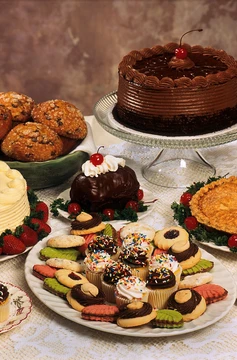
Trifle
Layered English dessert of sponge, fruit, custard, and cream.
Trifle is a layered dessert of English origin, typically consisting of ladyfingers or sponge cake soaked in sherry or fortified wine, a fruit element, custard, and whipped cream. Its name first appeared in the 16th century for a dessert similar to a fruit fool, and by the 18th century it evolved into a recognizably modern form with the inclusion of gelatin jelly.
- origin
- England
- first recorded name
- 1585, in Thomas Dawson's The Good Huswifes Jewell
- earliest modern recipe
- 1751, in Hannah Glasse's The Art of Cookery Made Plain and Easy and an anonymous The Whole Duty of a Woman
- first jelly inclusion
- 1760, in Hannah Glasse's 'A grand trifle'
- field
- Culinary history
- known_for
- Layered dessert with sponge, fruit, custard, and whipped cream
Lore & Background
The earliest use of the name 'trifle' was in Thomas Dawson's 1585 book The Good Huswifes Jewell, for a thick cream flavored with sugar, ginger, and rosewater, cooked gently like a custard and served in a silver bowl. These early trifles derived from flavored almond milk of medieval times and were more like fools—puréed fruit mixed with sweetened cream. The names 'trifle' and 'fool' were originally used interchangeably.
By the 1750s, trifles took the form many know today. Two recipes from 1751—one in the 4th edition of Hannah Glasse's The Art of Cookery Made Plain and Easy and another in The Whole Duty of a Woman—described biscuits soaked in wine layered with custard and covered in whipped syllabub froth. Jelly first appeared as part of a trifle in Hannah Glasse's 'A grand trifle' (1760), which used calves' feet to make a rich jelly, with biscuits and macaroons stuck into it before setting, then topped with thick sweet cream and decorated with jelly pieces, raspberry jam, and currant jelly.
The late 19th century was a heyday for trifles, with a bewildering number of recipes in print by the early 1900s. Theodore Francis Garrett's The Encyclopaedia of Practical Cookery (1891) included thirteen trifle recipes, two of which were savoury versions with veal and lobster. In 2022, a lemon Swiss roll and amaretti trifle was selected as the Platinum Pudding for Queen Elizabeth II's Platinum Jubilee, and in 2023, a Coronation Trifle with parkin, ginger custard, and strawberry jelly was created for the Coronation of King Charles III.
Reader's Guide
Trifle's significance lies in its long evolution from a simple flavored cream in the 16th century to a layered dessert that became a staple of English cookery. Its adaptability is evident in the many variations recorded over centuries, including the addition of jelly in the 18th century and the proliferation of recipes in the late 19th century. The dessert's cultural importance was underscored in the 21st century when it was chosen for royal celebrations: the Platinum Pudding in 2022 and the Coronation Trifle in 2023. Trifle also influenced similar desserts internationally, such as the Italian zuppa inglese and the Scottish tipsy laird. Its legacy is one of culinary flexibility, allowing for both sweet and savoury interpretations, and its enduring popularity as a celebratory dish in English-speaking countries, particularly as a Christmas dessert in Australia.
Did You Know?
- The earliest use of the name 'trifle' was in Thomas Dawson's 1585 book The Good Huswifes Jewell.
- Hannah Glasse's 1760 recipe for 'A grand trifle' used calves' feet to make the jelly.
- The 1891 Encyclopaedia of Practical Cookery included two savoury trifle recipes, one with veal and one with lobster.
- A trifle was selected as the Platinum Pudding in 2022 for Queen Elizabeth II's Platinum Jubilee.
Frequently Asked Questions
What is Trifle?
Trifle is a classic English layered dessert built from sponge cake or ladyfingers soaked in sherry, a fruit component, custard, and a topping of whipped cream. It is one of the most recognizable names in British culinary tradition.
When was Trifle first named in writing?
The word "trifle" first appeared in print in 1585 within Thomas Dawson's cookbook The Good Huswifes Jewell, referring to a dessert that resembled a fruit fool. The name stuck and eventually came to describe the layered confection we know today.
What are the traditional layers of Trifle?
A standard trifle stacks sherry-soaked sponge or ladyfingers, a fruit element, custard, and whipped cream in distinct tiers. Some versions also incorporate a gelatin jelly between the layers.
How did Trifle evolve into its modern form?
By the early 18th century, trifle had shifted from a simple fruit-based treat to the multi-layered dessert familiar today. The addition of gelatin jelly, first recorded in Hannah Glasse's 1760 recipe "A grand trifle," became a defining feature of the modern version.
Why is Trifle significant in culinary history?
Trifle traces a clear lineage from 16th-century English fruit desserts to the elaborate layered confection of the 1700s, making it a key example of how British home cooking evolved. Its first recognizably modern recipe appeared in 1751 in both Hannah Glasse's The Art of Cookery Made Plain and Easy and the anonymous The Whole Duty of a Woman.
More in Desserts 1-22
Spotted an error? Know more?
This is a living reference — every entry is fact-audited, and reader corrections feed straight into our audit queue. Suggest an edit · See this site's audit record